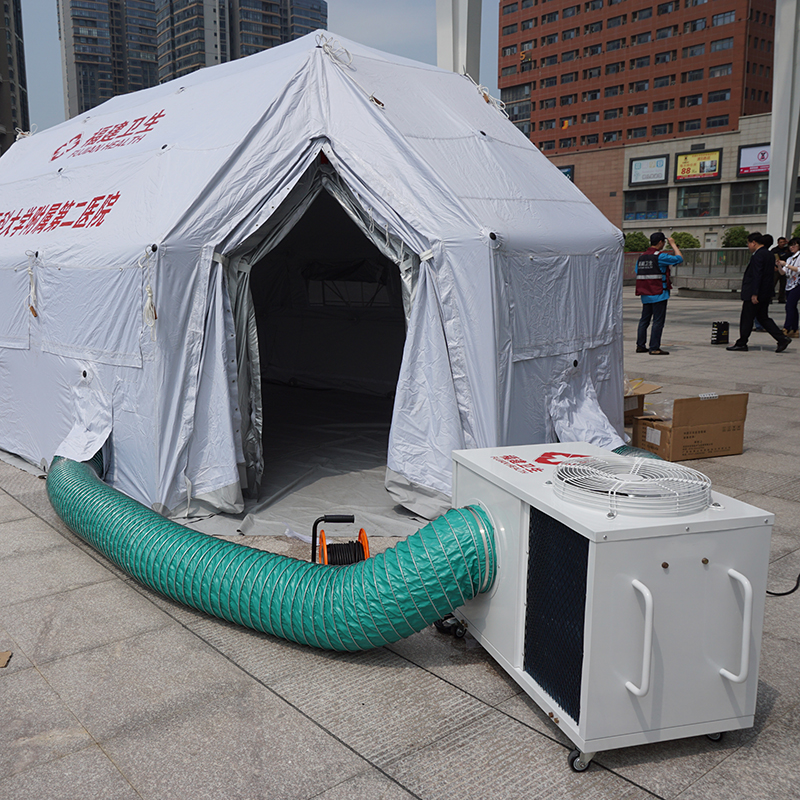
Take the modern Mobile Field Hospital & Medical Air Conditioner. These aren't your standard window units. They are built to handle a brutal reality: a sandstorm in the Middle East one week, humid jungle heat the next. The challenge isn't just about blowing cold air—it's about removing moisture without freezing the staff. A drop in humidity too low, and sterile drapes start generating static; too high, and you are breeding bacteria on surgical instruments. The sweet spot is a steady 21°C with 50% relative humidity, a target that is notoriously difficult to hit when your "roof" is made of fabric.
Speaking of fabric, the Tent Air Conditioner segment has evolved beyond simple spot coolers. Early models were loud, power-hungry, and leaked condensation everywhere. Modern ducted versions are now designed with low-ambient kits, allowing them to function even when outside temperatures plunge overnight. They push cooled air through insulated hoses that attach directly to tent grommets, creating a positive pressure environment that keeps dust and airborne contaminants out. It’s a brute-force approach, but it works for mass-casualty triage.
However, when you move past basic cooling into critical care, you need the ECU Environmental Control Unit. This is the heavy artillery. Unlike a standard AC, the ECU manages the entire atmospheric profile—temperature, humidity, and most critically, air exchange rates. In an infectious disease scenario, the ECU switches to negative pressure, pulling contaminated air through HEPA and carbon filters before exhausting it safely outside. It monitors CO2 levels from the breathing of the medical team inside and adjusts fresh-air intake automatically. It is less of an air conditioner and more of a life-support system for the enclosed space itself.
The real breakthrough? Integration. Manufacturers are now shrinking the ECU’s sensor suite and fitting it into the more compact Tent AC frames. We are seeing smart controllers that anticipate load changes—ramping up cooling the moment the surgical laser fires up, or dialing back during quiet recovery hours to save battery power. For forward operating bases relying on solar or generator power, this intelligence isn't a luxury; it is the only way to keep the lights on and the OR sterile simultaneously. The future of tactical medicine depends less on the scalpel and more on the quiet, precise hum of the unit keeping the air clean and the surgeon’s hands steady.