The image of a field hospital—a canvas tent pitched in a dusty clearing, surgeons working under flickering lights, patients lying on cots in suffocating heat—is being retired. Not because disasters have stopped happening. They haven't. But because the equipment that supports these temporary medical facilities has caught up with the urgency of the mission.
At the heart of this transformation is the medical air conditioner. Not the window unit you might find in a suburban home, but a new class of rugged, portable, mission-ready climate control systems designed to operate where infrastructure does not exist. These machines are doing more than keeping people comfortable. They are keeping patients alive, preserving critical medicines, enabling complex surgery, and protecting medical staff from the heat that has always been an unspoken adversary in disaster zones.
The Mobile Field Hospital: A Climate-Controlled Operating Room in a Box
The modern mobile field hospital bears little resemblance to its predecessors. FORTS USA, an industry leader in mobile field hospitals, now offers rapidly deployable, climate-controlled, hard-walled medical units that can transform any location into a fully functional healthcare facility in under 30 minutes. These units arrive with triage bays, exam rooms, surgical prep areas, recovery spaces, and—critically—integrated HEPA-filtered HVAC systems with negative pressure capability.
BLU-MED, another major player in deployable medical infrastructure, has taken the concept further. Its field hospitals are engineered as complete medical shelter systems with military-grade environmental control units. These facilities can scale from 15 to 100 beds and expand to 300+ beds by combining multiple units. They include triage, ER, ICU, surgical suites, isolation wards with negative pressure, general wards, pharmacies, and laboratories. Environmental control is not an afterthought—it is built into the core specification, with heating, cooling, HEPA filtration, and positive or negative pressure options.
The operational logic is straightforward. A field hospital deployed after an earthquake, hurricane, or disease outbreak cannot rely on the grid. It must be self-sufficient from the moment it arrives. BLU-MED's systems ship palletized or containerized, with a single 40-foot trailer capable of delivering a 12-shelter, approximately 9,000-square-foot medical facility. The environmental control units integrate during assembly, with color-coded connection points and standardized shelter sizes enabling parallel workflows.
The global field hospitals market reflects this growing institutional commitment. Valued at USD 2.04 billion in 2025, it is projected to reach USD 3.65 billion by 2034, growing at a compound annual rate of 6.6%. The modular hospital field solutions market—which includes the environmental control systems that make these facilities functional—was valued at USD 6.51 billion in 2025 and is expected to reach USD 10.23 billion by 2032.
The Tent Air Conditioner: Portable Cooling for the Most Vulnerable Settings
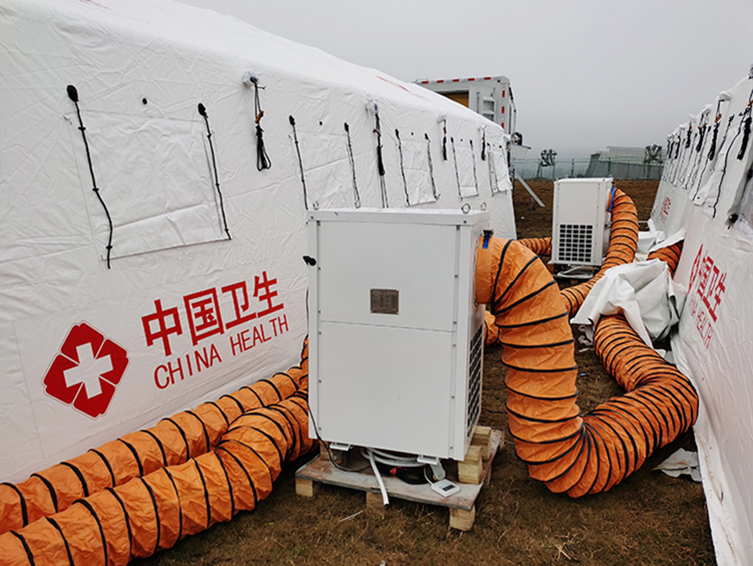
Not every emergency response requires a hard-walled medical unit. Sometimes the mission calls for tents—rapidly deployable, lightweight structures that can be erected in hours. But tents have a problem: they magnify heat. Canvas and synthetic fabrics trap sunlight, turning interiors into greenhouses. In tropical climates, temperatures inside a medical tent can exceed 55°C, making patient care nearly impossible and threatening the stability of temperature-sensitive medications.
This is where the tent air conditioner—a specialised portable cooling unit designed specifically for temporary structures—has become indispensable. Dantherm, a Danish manufacturer whose climate control solutions have supported military and humanitarian field camps for over 35 years and have become the NATO standard for field-deployable mobile heating, cooling and drying units, produces a range of tent coolers engineered for the harshest environments.
The AC-M11, one of Dantherm's workhorses, is a compact, lightweight aluminium unit built into a rigid steel frame. Placed outside the tent, it ducts supply and return air through insulated connections. The unit draws warm internal air through a cold evaporator and blows cooled air back into the structure. With 37,500 BTU of cooling capacity and optional electric heating for nighttime temperature drops, it operates in ambient temperatures from +68°F to +140°F.
For more demanding medical applications, Dantherm offers the AC-M18 CBRN—a portable unit designed specifically for field hospitals where filtration requirements exceed those of normal accommodation. The AC-M18 CBRN features a dual filtration system for the internal air path, with an optional HEPA filtration configuration that removes airborne particles including virus-laden aerosols. This is critical in outbreak settings such as Ebola response zones, where strict infection control is paramount. The unit delivers 17.5 kW of cooling capacity, operates in ambient temperatures up to +60°C, and can be configured with optional CBRN filtration for protection against biological threats.
The impact of these systems extends beyond temperature control. High temperatures and humidity accelerate bacterial and viral growth. Heat causes significant fluid loss in patients and staff, leading to dizziness, confusion, and organ strain. It impairs cognitive function, increasing the risk of medical errors. It degrades medications—many lose potency when exposed to high temperatures. A tent air conditioner is not a luxury. It is a patient safety device.
The Military Tent Air Conditioner: Built for the Edge of the Map
Military field operations present a different order of challenge. A disaster relief tent may be deployed for weeks. A military field hospital may operate for months in a combat zone, subject to repeated relocation, extreme weather, and the constant threat of equipment failure. The equipment that supports these missions is not called an air conditioner. It is called an Environmental Control Unit, or ECU—and the terminology matters.
ECUs are HVAC systems designed to operate in more extreme ambient conditions than commercial units. They must function seamlessly anywhere on the planet—from the deserts of the Middle East to the jungles of Southeast Asia to the Arctic. They must be transportable, stackable for logistics efficiency, and rugged enough to survive repeated deployment cycles.
HDT Global's F100-60K ECU delivers 60,000 BTU/hr of air conditioning and is designed to be used outside a tent or shelter, positioned on the ground or mounted on a trailer for increased portability. The unit is lighter than competitive systems, with low power consumption and a noise level of 75 dBA. Western Shelter offers an all-in-one ECU that handles air conditioning, dehumidification, and heating—42,000 Btu/hr for cooling and 40,000 Btu/hr for heating—in a single package.
At Eurosatory 2026, the international defence exhibition held in Paris, Thermo Projects Ukraine—a Ukrainian manufacturer of climate systems for military equipment and mobile structures—presented the BOREY TENT 120 NG mobile air conditioner. The system provides cooling, heating, and ventilation for tents, field hospitals, and containers with volumes up to 60 m³. With 11 kW of cooling capacity and 12 kW of heating capacity, it uses a modern compressor compatible with both R1234yf and R134a refrigerants and carries CE certification. The company's stated philosophy captures the imperative: "Modern field operations require reliable climate control solutions that can be deployed quickly, easily transported, and operate in demanding conditions".
Weiss Defence, another specialist in this space, produces the ZKB 20/18 tent air conditioner, with cooling output up to 18 kW and heating output up to 30 kW, designed for field camps, mobile hospitals, and mobile clean rooms. The ZKB 15/10 MFA is rated for extreme operating temperatures from -32°C to +58°C and can be deployed across multiple climatic zones in accordance with STANAG 2895, the NATO standardisation agreement.
The New Calculus of Field Medicine
The cumulative effect of these advances is a fundamental shift in what is possible in disaster response and military healthcare. A field hospital with properly engineered climate control can perform surgeries that would be impossible in a sweltering tent. It can store vaccines and biologics that would otherwise spoil. It can isolate infectious patients without risking the rest of the facility. It can keep medical staff—already working under extreme stress—from succumbing to heat exhaustion.
This is not incremental improvement. This is a redefinition of the standard of care in temporary settings. The equipment exists. The logistics have been solved. The only question that remains, as climate change drives more frequent and more severe extreme weather events, is whether response organisations will invest in the systems that make field healthcare not just possible, but safe.
The tent air conditioner, the mobile field hospital HVAC system, the military ECU—these are not glamorous technologies. They do not make headlines. But they are the difference between a field hospital that saves lives and one that merely provides shelter. And in the chaos of a disaster zone, that difference is everything.