The global field hospitals market was valued at USD 2.04 billion in 2025 and is projected to reach USD 3.65 billion by 2034. But a field hospital is only as good as the environment inside it—and that’s where specialized cooling comes in.
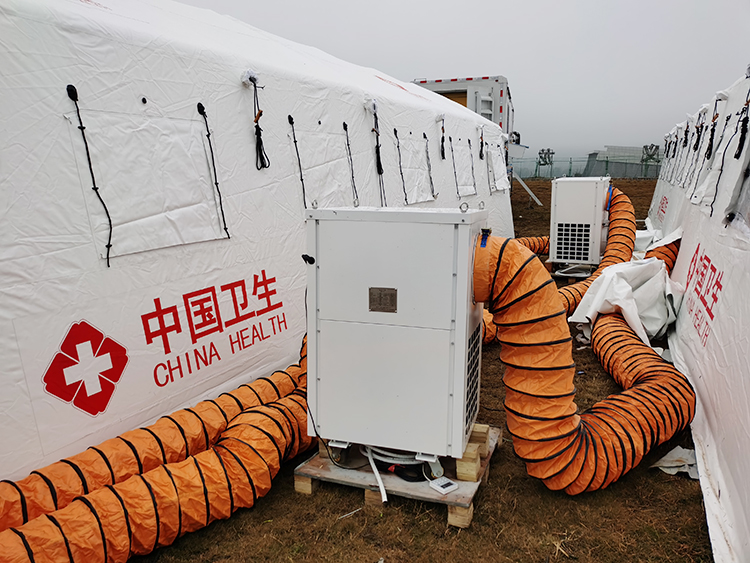
Military Tent Air Conditioner units have evolved far beyond standard portable ACs. These are ruggedized systems built to withstand temperatures from -26°F to +131°F while maintaining stable interior conditions. Dantherm’s AC-M25 tent cooler, for example, delivers 93,000 BTU of cooling and 16 kW of electric heating in a compact monobloc design. The unit is deployed externally, supplying conditioned air through insulated flexible ducts with dual G4/MERV7 filtration standard and optional F7 (MERV13). Built from corrosion-protected aluminum with a galvanized steel frame, it’s designed for logistics efficiency—stackable up to three units in storage.
At the heart of these systems is the ECU Environmental Control Unit—the military’s term for a purpose-built HVAC system. Unlike commercial units, ECUs are engineered for mobility, ruggedness, and extreme temperature performance. A 5-ton ECU typically delivers 60,000+ BTU of cooling, maintains 20°C to 26°C in cooling mode, and meets MIL-STD-810 for environmental testing. The market is seeing serious investment: HDT Global recently secured a $450 million, 10-year contract for Improved Environmental Control Units (IECUs), while Advanced Cooling Technologies launched its Vaphtek Hybrid ECU, which can reduce power consumption by up to 70% in favorable conditions by integrating vapor compression with pumped two-phase cooling.
Innovation is also coming from novel approaches. The U.S. Department of Defense awarded a grant for RAEKOR’s Evaporative Environmental Cooling Unit (EECU), which uses water evaporation rather than refrigerant compressors—cutting power requirements to 10%, weight to 20%, and size in half compared to conventional ECUs.
On the ground, deployments are accelerating. BLU-MED offers customizable mobile field hospitals with optional HVAC/ECU systems that manage temperature, airflow, and filtration across climates. FORTS USA’s mobile field hospitals now feature integrated HEPA-filtered HVAC with negative pressure capability. Dantherm, whose systems are NATO-listed and developed in close cooperation with armed forces, continues to expand its portfolio of field-ready climate control technologies.
As extreme weather events and conflict zones drive demand for deployable healthcare, the message is clear: in the field, climate control isn't a luxury—it's mission-critical. And the technology is finally catching up.