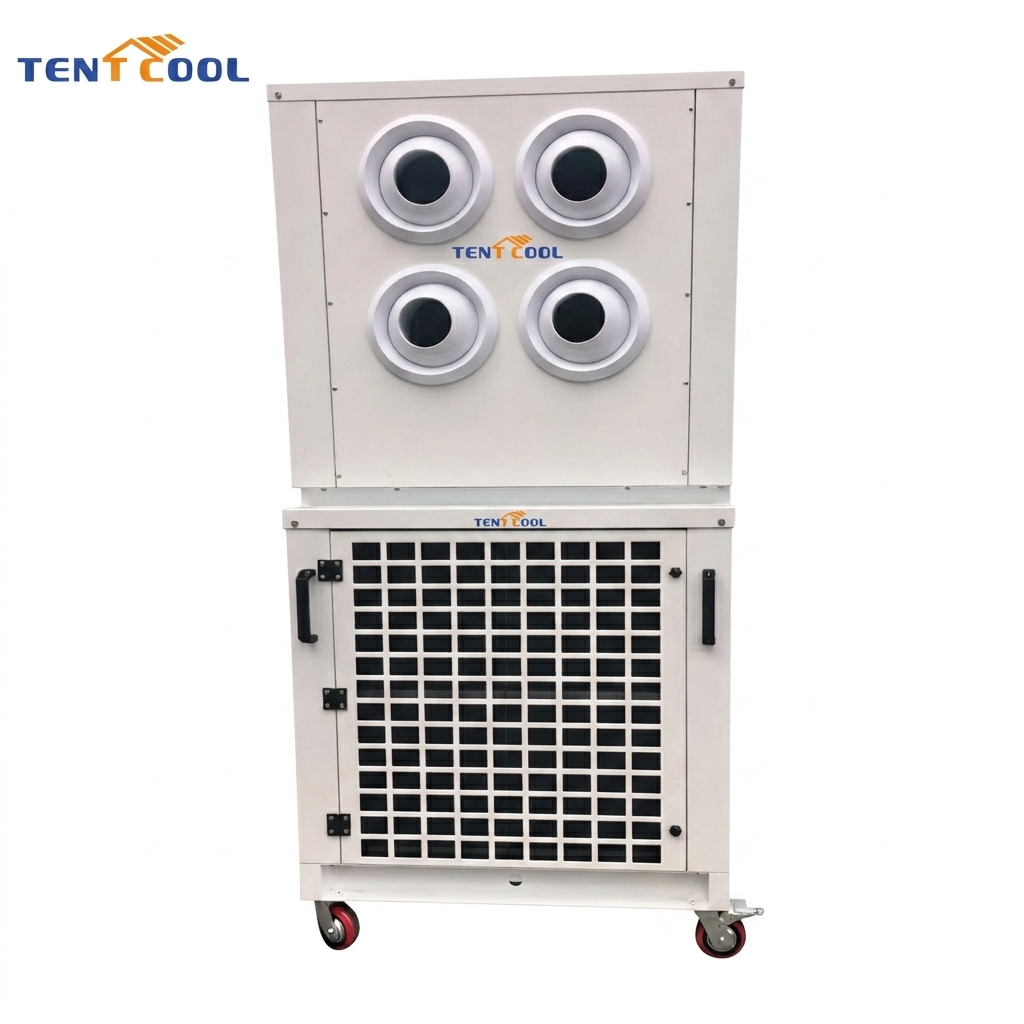
Event tent air conditioner units have evolved specifically to address this risk. Unlike standard residential ACs that struggle with the transient loads of a tent environment, purpose-built units feature high-static pressure fans that push cooled air through long duct runs. This matters because tents aren't rectangular rooms with predictable airflow. They're fabric structures that flex in the wind, absorb radiant heat, and lose conditioned air through every seam and entry flap. A properly sized event tent air conditioner doesn't just lower the temperature—it maintains consistent dew points that keep humidity from rising to oppressive levels, which is precisely when heat stress accelerates.
The reality of tent events is that cooling isn't a luxury. It's liability management. When a guest suffers heat exhaustion, the event stops. Ambulance calls, insurance claims, and reputational damage follow. That's why professional rental companies now insist on calculating cooling loads based on occupancy counts, solar gain, and ambient temperatures, not just tent square footage. A tent air conditioner designed for these variables delivers staged cooling that stabilizes the environment even as crowd density fluctuates.
But temperature is only half the equation. Air quality deteriorates rapidly in sealed temporary structures. This is where the ECU Environmental Control Unit concept becomes critical. An ECU Environmental Control Unit, as defined in industrial climate systems, goes beyond simple air conditioning—it integrates ventilation, filtration, and humidity management into a single coordinated platform. For an event tent, an ECU Environmental Control Unit can cycle fresh air through the space while exhausting stale, CO₂-rich air from the top of the tent, where heat naturally accumulates. This active exchange prevents the stuffiness that makes guests want to leave early.
The smart play for event organizers is moving beyond the cheapest rental quote. An undersized tent air conditioner running continuously will freeze its own coils, trip breakers, and fail during the peak heat of the afternoon when it's needed most. Conversely, an oversized unit short-cycles and fails to dehumidify, leaving guests sticky and uncomfortable. The right solution accounts for duct layout, fabric reflectivity, and even the direction the tent faces relative to the sun. With extreme heat becoming the norm rather than the exception, the event tent air conditioner has shifted from an optional upgrade to a non-negotiable requirement for guest safety and satisfaction.