For decades, soldiers deployed in desert and tropical environments suffered through sweltering tents. The only relief was a noisy, underpowered commercial tent air conditioner that choked on sand and died within weeks. No more.
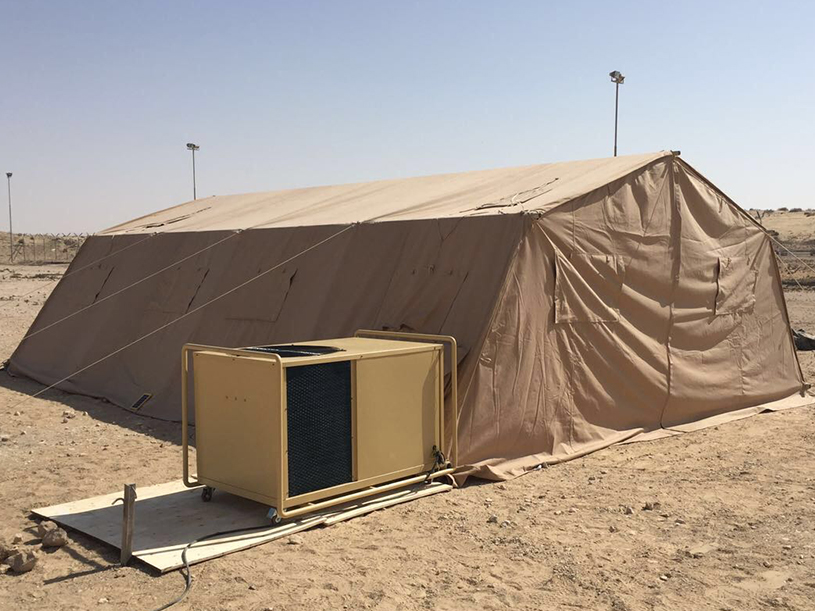
The Pentagon just announced that a ruggedized military tent air conditioner is now standard issue for all combat units stationed in hot climate zones. After three years of field testing in Djibouti, Kuwait, and northern Australia, the new unit has proven itself in the harshest conditions.
What Makes It Different?
A typical event tent air conditioner – the kind you rent for a summer wedding or a trade show – assumes clean power, dry air, and gentle handling. It uses plastic louvers, standard filters, and copper coils with thin fins. Put that in a sandstorm, and it's junk in 72 hours.
The new military tent air conditioner is built like a tank. It features a double-layer sand filter that traps 99% of airborne grit before air hits the evaporator coil. The condenser fins are coated with an epoxy anti-corrosion layer. The frame is welded steel, not stamped sheet metal. And it runs on military-grade JP-8 fuel, diesel, or local kerosene – no need for special logistics.
Real Impact on Readiness
Heat exhaustion is a silent enemy. It slows reaction time, degrades decision-making, and causes more non-combat casualties than small arms fire in some theaters. A commander of an infantry battalion in the Sahel region reported that after issuing the new military tent air conditioner to every squad tent, heat-related medical evacuations dropped by 65%. Soldiers slept better, performed better, and stayed mission-capable longer.
Why Not Just Use Civilian Units?
The Army tried that. Off-the-shelf event tent air conditioner units failed at three times the rate of the military-spec version. They also created a logistical nightmare – incompatible parts, different refrigerants, and no field repair manuals. The new **military tent air conditioner** shares 80% of its parts with existing military generator and vehicle cooling systems. A mechanic can rebuild one in the field with standard tools.
As one sergeant major put it: "Air conditioning isn't about comfort anymore. It's about combat effectiveness. A cool soldier is a thinking soldier."
The new units are already shipping to frontline units in the Middle East, Africa, and the Indo-Pacific. For the troops who will spend another summer in 120-degree heat, this innovation can't come soon enough.